
How do we truly make research disability-led?
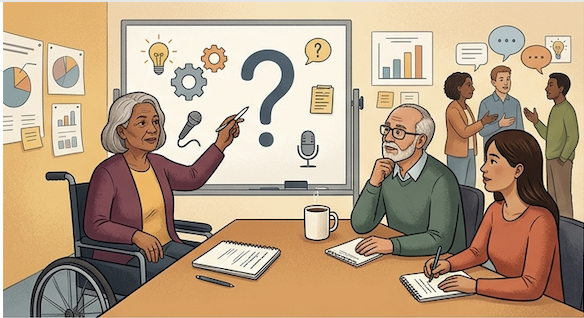
A reflection on power, participation, and what inclusive research actually demands of us.
Disability and inclusivity have become the dominant vocabulary of the last decade, carried forward by social movements determined to amplify voices that institutions have long ignored. The response, predictably, has been cosmetic. Accessibility stickers on bathroom doors. Ramps at hotel entrances. A wheelchair symbol bolted to the wall. These gestures signal compliance; they rarely signal access. The gap between claiming to be accessible and actually being accessible is one that no ramp can bridge… and everyone knows it.
The same logic infects research. A disabled person is added to an advisory panel. Materials appear in one additional format. A land acknowledgment opens the first meeting. Then the research proceeds exactly as it always would have, the same questions, the same assumptions, the same people making every decision that counts. That is not disability-led research. That is tokenism with a better logo.
Real disability-led research requires a fundamentally different orientation and, crucially, a real sacrifice from researchers who don't have disabilities. Not just openness to feedback. Not just a seat at the table. Actual surrender of control: over which questions get asked, which methods get used, how findings get interpreted, and whose name appears on the publication. Power has to be shared, not performed.
What it actually means to share power
In practice, sharing power in research is not a gesture - it is a series of concrete commitments. Here is what that looks like in our project.
Decision making power
Parents with disabilities are not participants whose responses we analyze - they are on our steering committee. They do not answer the questions we designed; they decide which questions deserve to be asked at all. They approve research materials, guide recruitment, and co-author publications. This is not a courtesy. It is the structural minimum for research that claims to center disability.
Compensation and Recognition
Expertise, including lived expertise, deserves compensation. Sitting in meetings, reviewing protocols, and bringing years of navigating inaccessible systems to a research design conversation: that is intellectual labor, not volunteering. Honoraria, covered transportation, and support for childcare are not perks. They are preconditions for equitable participation.
Accessibility by design, not as afterthought
Accessibility was not added to the end of the design process. We started there and built everything else around it. Every material exists in multiple formats : visual, audio, text. Meeting times are set by participants, not by researchers' calendars. Technology choices are made based on access needs, and those choices are revisited as the project evolves.
The power to say NO
Participants retain the right to decline, withdraw, or disagree with our interpretations at any point, without consequence. That last part is important: if true refusal is not possible, then consent is not meaningful. Partnership requires that disagreement be genuinely safe - not tolerated in theory and penalized in practice.
What it actually means to share power
Disability-led research takes more time. It costs more money. It requires researchers to give up control and it challenges conventions that the academy has spent decades reinforcing. Universities want quick timelines. Funders want efficiency. Academic culture rewards individual achievement over collaboration. None of that is compatible with building the kind of trust and reciprocity this work demands.
But fast research is not good research when it excludes the people most affected by its conclusions. Speed is not a virtue if it comes at the cost of relevance.
What we are trying to build instead is something more durable:
Research that moves at the speed of trust, not the speed of grant cycles.
Partnerships that outlast any single funding period.
Knowledge that is shaped by and genuinely useful to disabled communities.
Change that disabled people lead - not change designed for them by people who have never lived it.
The stakes of that commitment extend well beyond any single project. Disability-led research is not simply a methodological improvement, though it is that too. It is a claim about who holds knowledge and who gets to shape it. Every time a disabled parent challenges an ableist assumption embedded in our protocol, or names a question we had not thought to ask, they are exercising a form of authority that the academic system typically denies them.
Research can participate in the disability rights movement, or it can reproduce the structures it claims to critique. We are trying, imperfectly and iteratively, to do the former - and to be honest about what that requires.
What we are learning
The most consistent finding so far is one that perhaps should not be surprising: parents with disabilities know what questions matter, and they are better co-researchers than most academic collaborators I have worked with. They bring precision, candor, and a clarity about stakes that is difficult to manufacture in a seminar room.
We are also learning where we fall short and being transparent about that is part of what distinguishes accountability from performance. We are not doing this perfectly. There are areas where academic timelines have created pressure that conflicts with the principle of moving at the speed of trust. There are moments where institutional requirements have pushed against the flexibility our partners need. We are working on it, and we are changing our approach as we go.