
How do We Adapt Photovoix to Ensure Everyone Can Use It?
The Problem With "Traditional" Photovoice
Photovoice is one of the most cited participatory research methods in community-based work. The premise is compelling: give people cameras, let them document their own lives, and use those images to drive policy conversations. It centers lived experience. It shifts the narrative away from researchers and toward the people being studied. On paper, it sounds like exactly the kind of methodology disability-led research should embrace.
Except it wasn't built for us.
Traditional photovoice asks participants to take photographs, write captions, attend in-person group discussions, and present their work to policymakers. Every single one of those steps contains a barrier. People with visual disabilities cannot take or interpret photos. People with dexterity differences struggle with cameras. People who don't communicate through writing are excluded by the caption requirement. People with fluctuating conditions cannot commit to fixed schedules. People who face communication barriers are left without accommodation. If we had run photovoice the way it was designed to be run, we would have reproduced the exact dynamic we set out to study: a system that treats disabled people as subjects rather than authors of their own experience.
So we didn't. We rebuilt it.
Our Adaptations
1. Multiple documentation formats
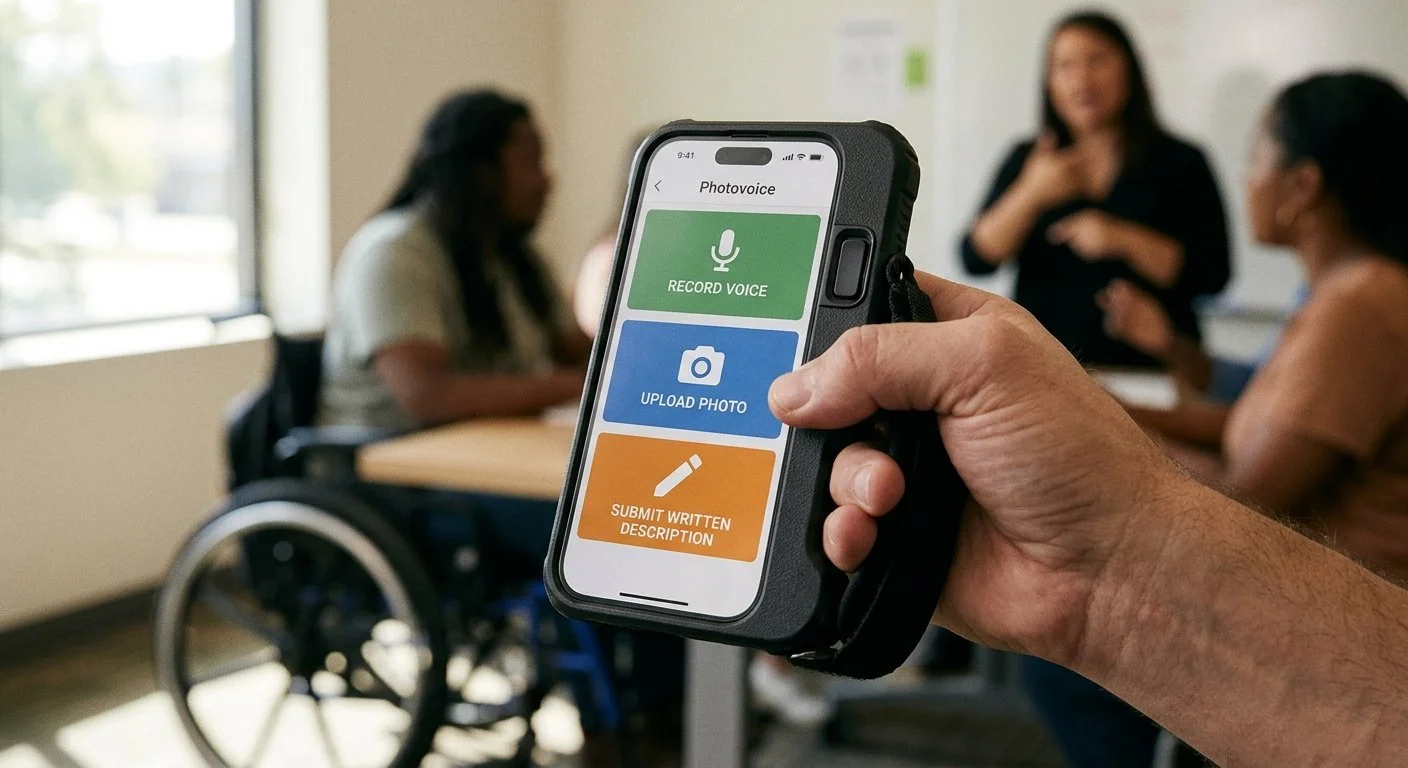
The first thing we did was let go of the photograph as a requirement. Instead, participants can submit whatever format allows them to document their experience most fully. That means smartphone or camera photos, including images taken by a support person under the participant's direction. It means voice recordings ; audio descriptions of environments, narrated observations, voice memos of up to two minutes. It means written descriptions, short or long, typed or dictated. It means voice captions instead of written ones. And crucially, any combination of these works. A participant might submit mostly photos with occasional voice memos. Another might use only written descriptions. Both carry equal weight in the research.
This is not about lowering the bar. It is about removing the assumption that there is only one valid way to document an experience.
2. Flexible participation timelines
Traditional photovoice runs on a shared calendar. Everyone submits at the same time, attends the same sessions, and moves through the process at the same pace. That structure assumes a kind of bodily predictability that disability routinely refuses. Pain flares. Energy crashes. Caregiving demands shift without notice. Access to the spaces being documented varies.
Our approach treats submission deadlines as guidelines, not gates. Participants submit when they can. Extensions are available without explanation. Contributions made later in the project are not treated as lesser. If someone encounters a new barrier three months in, they can still document it. The research stays open because the lives we are studying do not close on schedule.
3. Accessible technology
Every platform decision was made through an access lens. The submission tool had to be mobile-friendly, screen reader compatible, functional with voice-to-text, and usable on low-bandwidth connections. We chose Qualtrics because it met accessibility standards, accepted multiple file types, worked across devices, and was already familiar to many participants from other surveys. We also made sure that the technology was backed by human support not just an FAQ page, but actual troubleshooting help and alternative submission pathways for anyone the platform failed.
4. Interviews adapted to participant needs
Where traditional photovoice funnels everyone into in-person group meetings, we offer a full range of options: video calls, phone calls with no video requirement, in-person meetings in the participant's own community, and asynchronous written exchanges for those who cannot or prefer not to participate in real time. Support persons are welcome. ASL interpretation and translation services are available. Questions are shared in advance. Sessions can be rescheduled without penalty. The interview serves the participant, not the other way around.
5. Focus groups redesigned
The group discussion is where photovoice generates some of its most valuable material, the moments where individual experiences become collective analysis. We did not want to lose that. But we also could not run it as a single room, single session, everyone-at-once event.
Our solution was to make the group itself flexible. Sessions are virtual, eliminating travel. Groups are smaller (six to eight people) and organized around shared disability context where possible. Multiple session times allow participants to join when they can. For anyone who cannot attend live, written input is incorporated into the group record. Within sessions, visual aids support Deaf participants, audio descriptions of photos support blind participants, and the chat function gives people who prefer typing a full voice in the conversation.
What We’re Still Learning - And Why We Keep Asking
We are not done. Despite everything above, we know there are barriers we have not yet solved and probably some we have not yet seen.
We are still working out how to fully support parents with intellectual disabilities who want photos described to them in a way that serves their own analysis, not ours. We are still figuring out how to make voice recordings genuinely accessible to Deaf participants through transcription that captures tone and context, not just words. We are navigating the tension between brevity and detail for participants with cognitive access needs, where too much information is itself a barrier. We are trying to reach people with limited internet access through mailed USB drives and offline preparation options, while knowing that those workarounds carry their own friction.
The steering committee reviews our methods on an ongoing basis. Participants can give feedback anonymously at any point. We change things when they are not working not at the end of the project, but in the middle of it, because waiting until the research is over to fix a barrier means the people that barrier affected never got to participate fully.
What we are sitting with right now: Are we unconsciously favouring certain types of submissions? Do our flexibility options actually feel flexible to participants, or do they just feel like a longer list of requirements? What are we still not seeing?
We do not have clean answers to those questions. But we think asking them out loud - here, in writing, as part of the public record of this project - is part of what disability-led research actually looks like.
It Shouldn't Stop Here
Adapted photovoice matters beyond this project. We are not just trying to make our own research more inclusive, though that matters enormously. We are trying to make the excuse disappear. Researchers can no longer say that photovoice does not work for disabled participants. We are showing, in real time, how to do it differently. We are creating a model that other teams can take, criticize, and improve. And we are trying to shift what participants with disabilities should expect from research: not heroic individual effort to squeeze into a process that was never designed for them, but a process that was built around what they actually need.
Every parent with a disability who wants to participate should be able to participate fully. That is the goal. Everything above is what working toward it looks like.